Can You Anchor Here? What Yacht Owners in Mallorca Need to Know About Posidonia in 2026
Every summer, a handful of owners in Mallorca get an unwelcome visit from a small grey patrol boat — and a fine that can run into the thousands. Almost always, the cause is the same: an anchor dropped on Posidonia.
This is a plain-language guide to the rules for 2026: what Posidonia is, where you can and can’t stop, what it costs to get it wrong, and how to book a legal mooring. It’s written for absentee owners who keep a boat in Palma and want to know their vessel is being handled correctly when they’re not on board — because staying on the right side of these rules is now a basic part of good yacht care in Mallorca.
First, what Posidonia actually is
Posidonia oceanica is a slow-growing seagrass found only in the Mediterranean. Around Mallorca and the rest of the Balearics it forms roughly 650 km² of underwater meadow, and it does a lot of quiet work: it oxygenates the water, keeps the sea that famous clear turquoise, stabilises the seabed, and shelters marine life.
It’s also fragile. A large yacht dragging its anchor and chain across a meadow can tear up a startling amount of it — figures cited by the regional service put the damage from a single 100-metre yacht at up to 10,000 m² in one day. Because it grows back so slowly, the Balearic government treats it as a protected priority habitat.
The short answer: no, you can’t anchor on it
Since the Balearic Posidonia Protection Decree of 2018 (Decreto 25/2018), anchoring on Posidonia is prohibited across Balearic waters. The rule is simple and absolute: neither your anchor nor your chain may touch the seagrass. You anchor on sand, or you take a designated buoy — those are the only two compliant options.
And this is enforced. Between roughly May and October, the Servei de Vigilància de la Posidònia runs a fleet of around 18–20 patrol boats, six of them working Mallorca’s coast, carrying out well over 150,000 vessel inspections a season. If they catch you over seagrass, you’ll be told to move to sand or a buoy; refusing to move is what turns a warning into a penalty.
The good news for the ecosystem — and a sign of how normal these checks now are — is that the violation rate has fallen from around 18% when the programme started in 2017 to roughly 4–6% today. In other words, most captains already know the rules. You want to be in that majority.
What it can cost you
Penalties under the decree scale with the severity of the damage, and the ceiling is high — serious cases can reach into the hundreds of thousands of euros, with national environmental law going higher still. In practice, the on-the-water fines owners actually see are more modest but far from trivial:
- Minor first infringements: often in the low hundreds of euros.
- Standard enforced fines: commonly reported around €3,000 for anchoring on protected seagrass.
- Repeat or serious damage: four figures and up, climbing quickly.
Set against that, a booked buoy costs a small length-based fee per night — a rounding error next to a €3,000 fine, and cheaper than a marina berth. The economics only point one way. (For where mooring fits in the bigger picture, see what it actually costs to keep a 40–60ft yacht in Mallorca.)
Where you can legally stop
Two options, in order of preference:
1. A designated ecological buoy. PortsIB runs eight ecological buoy fields across the Balearics, with a few hundred buoys in total. On Mallorca the main fields are at Sant Elm / Sa Dragonera, Cala Blava (Cap Blanc) and Formentor. The buoys are colour- and size-coded so boats moor on gear rated for their length:
Red — under 8 m
White — 8 to 15 m
Yellow — 15 to 25 m
Green — 25 to 35 m
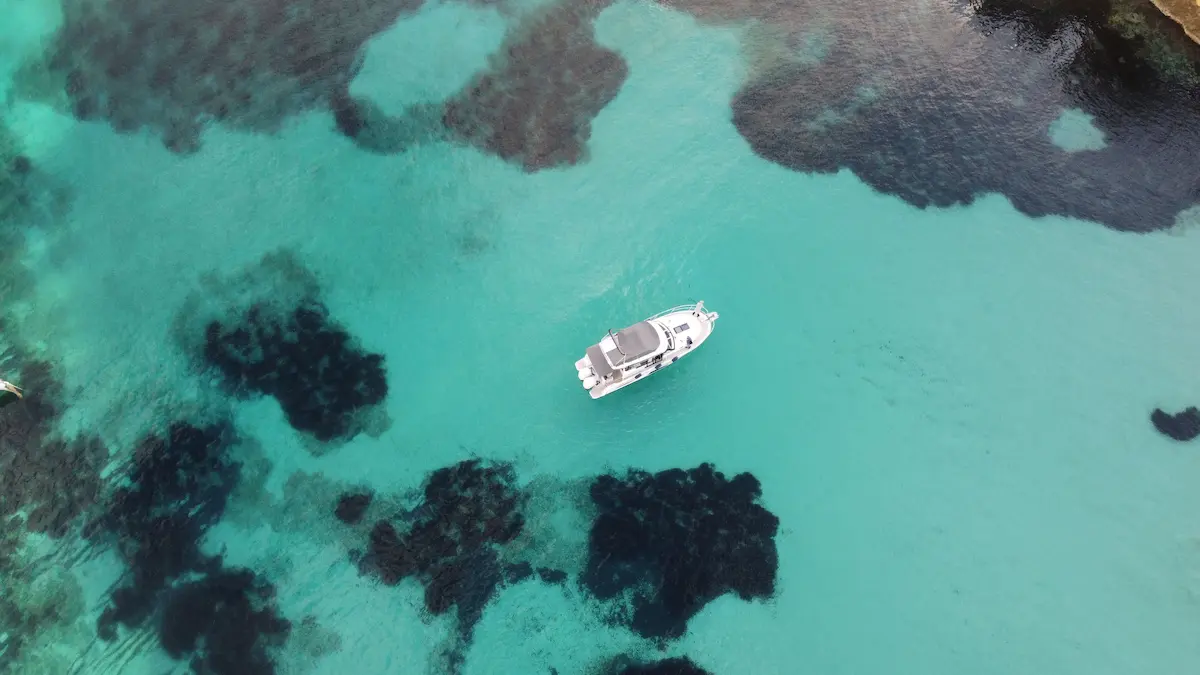
2. A clean sandy patch, away from the meadow. Where there’s no buoy field, you anchor on sand. From the surface, sand reads as a light, pale bottom; Posidonia shows as darker patches. Drop on the light, never the dark — and as the old hands say, the anchor won’t hold in seagrass anyway.
One important caveat: the Cabrera national park is managed separately, has its own booking system (reservasparquesnacionales.es), and carries stricter overnight limits. Treat it as its own set of rules.
And a safety note: a buoy is a fair-weather stop, never a storm refuge. If heavy weather is forecast, your boat belongs on secure lines in a marina — see our captain’s guide to storm season in Mallorca for how we prepare.
How the buoy booking system works in 2026
Buoys are booked online through reservas.portsib.es. A few things owners and their captains need to know:
- You have to register first. The portal requires the vessel’s details plus owner and insurance/registration documents, and issues a yacht-specific code you’ll need for every booking. Set this up before the season, not on the day you want a mooring.
- Buoys are bookable for boats up to around 25 m in the PortsIB fields (up to 35 m in the separately managed Cabrera field).
- The season runs roughly June through the end of September, sometimes extended into mid-October depending on demand.
- Demand is real. In peak weeks the popular fields fill. Booking ahead — the system opens the window a set number of days before arrival — is the difference between a legal, stress-free stop and circling a full bay at 6pm.
The tools that keep you compliant
You don’t have to guess where the seagrass is. Before anchoring, check a Posidonia map:
- The official government viewer at ideib.caib.es/posidonia shows the mapped meadows and buoy fields.
- The Balearic Marine Cluster digital nautical guide covers 250+ beaches and coves with anchoring information, including the IBANAT Posidonia map.
Cross-check the map against what you can see over the side, and you’ll rarely get it wrong.
Mistakes we see repeatedly
- Assuming “it’s just for the big boats.” Unlike some French zones, the Balearic ban applies to all vessels regardless of size. A 40-footer gets fined the same as a superyacht.
- Booking the buoy on the day. No registration, no yacht code, no mooring — and the good fields are already gone.
- Reading the bottom wrong in poor light. Late-afternoon glare hides the dark seagrass patches. When in doubt, take the buoy.
- Trusting last year’s memory. Buoy fields, size categories and the booking portal have all changed in recent seasons. Check the current rules each spring.
The real question isn’t “can I anchor here”
For an owner living in London, Munich or Zurich, the honest question isn’t which cove is legal today — it’s who’s making that call on your behalf when you’re not aboard.
That’s where a captain-led setup earns its keep. When we move or reposition your boat here in Palma, we already know which fields are open, we hold the PortsIB registration, and we anchor on sand — not seagrass. You get a WhatsApp photo showing exactly where she’s sitting and that she’s legally and safely moored. No fine landing in the post months later; no surprise on the next visit — the kind of quiet problem we cover in the real cost of leaving a yacht unattended in Mallorca.
How we work
At Mallorca Yacht Management we’re a captain-led yacht guardianage and management service based in Palma de Mallorca. For absentee owners, that means one local point of contact who actually goes to the boat — not an office that files paperwork.
Handling anchoring and mooring correctly is just one thread of the wider yacht care in Mallorca we provide: routine checks, maintenance coordination, keeping your registrations and compliance current, and regular WhatsApp updates so you always know your boat’s condition and whereabouts. Predictable monthly cost, continuous oversight, and someone who can be on the dock within the hour.
The takeaway
Anchoring on Posidonia is banned across the Balearics, patrolled from May to October, and fined — commonly around €3,000. Stay compliant by mooring on a booked PortsIB buoy or anchoring on clean sand, checking the ideib.caib.es viewer first, and registering on reservas.portsib.es well before the season. For owners who aren’t on the island, the simplest safeguard is having a captain-led team on the ground who does all of that as a matter of course.
Related reading
Marina Security vs Yacht Guardianage: What’s Actually the Difference?
The Complete Yacht Maintenance Checklist for Mallorca Owners (12-Month Plan)
Complete Yacht Services in Palma de Mallorca: 2026 Owner’s Guide
Want to know your boat is being handled right while you’re away? Request a free yacht assessment — an honest review of your current setup in Palma, no obligation.
Or download our free Annual Yacht Owner’s Checklist for Mallorca for the month-by-month essentials of keeping a boat here: /free-yacht-checklist/